
 The Humanizing Institute

A proposal for the California Community Colleges
Human connection is the missing piece of AI-era professional development.
The Humanizing Institute would bring human-centered, future-ready teaching to the California Community Colleges and foster cultures of inclusion and academic integrity through intrinsic motivation. It prioritizes instructor-student relationships as the connective tissue of equitable teaching and learning and taps into students’ real world experiences as opportunities for knowledge construction and authentic demonstration of skills. The implementation model strategically leverages the Regional PD Networks and statewide UDL initiative with opportunities to partner with external funders, while also supporting faculty wellbeing through relationship-rich professional learning.
California has already invested $2 million in this work
From 2019 to 2024, two grants from the California Education Learning Lab, a state-funded entity, supported the Humanizing Online STEM Academy, administered by Foothill-De Anza Community College District. More than 330 faculty completed the program, and research partners at UC Irvine studied what changed for participating faculty and the students in their humanized classes. The results show humanized teaching narrowing, and in some measures reversing, racial equity gaps. The Humanizing Institute builds directly on this foundation.
+12.6 pts
Greater gain in pass rates for students from minoritized groups than for their peers, reversing a 6.1-point gap.
+11.4 pts
Greater gain in course persistence for students from minoritized groups than for their peers, reversing a 3.1-point gap.
Gap closed
A 0.307 grade-point gap in course grades, closed by a 0.315-point greater gain for students from minoritized groups.
How the study worked. UC Irvine researchers used a difference-in-differences design with de-identified transcript data from three partner colleges (Spring 2017–Fall 2023). They tracked student outcomes in 14 asynchronous online STEM courses before and after instructors completed the Academy, and compared those changes with the same courses taught by non-participating instructors over the same period. Comparing the two sets of changes filters out shifts that affected all students, such as new policies or curriculum changes. The model also accounted for student demographics, course, term and instructor (Ledezma, Xu & Pacansky-Brock, 2025).
At Bakersfield College
After 34 faculty completed the Academy, course success rates rose significantly from 64% to 68%.
- African American students: 57% to 66%
- Hispanic/Latino students: 61% to 68% (statistically significant)
- Students of two or more races: 61% to 72%
Bakersfield College Academic Technology, Fall 2024.
How faculty teaching changed
- Personalized course homepages: 55% to 99%
- Surveys to identify high-opportunity students: 27% to 96%
- Instructor social presence online: 63% to 97%
- Self-efficacy in online teaching: 4.02 to 4.58 (of 5)
52 instructors, five institutions, pre/post surveys (Ledezma, Xu & Pacansky-Brock, 2025).
Statewide student voice
Students’ most satisfying online courses send signals of care
In a fall 2024 survey of 31,647 California community college students, conducted for the Legislature’s SB 117 study of online education, the largest difference between students’ most and least satisfying online courses was how interested and engaged they felt with the course material. Personal interactions with the instructor were also especially salient. In their most satisfying courses, students were far more likely to feel valued and appreciated and to believe their instructor genuinely wanted them to succeed (The RP Group, 2025).
Engaging activities and caring interactions are exactly what humanized course design and teaching are built to deliver, and they land with students as signals of care.
| Experience | Least satisfying | Most satisfying |
|---|---|---|
| Felt the instructor wanted and helped me to succeed | 39% | 86% |
| Actively engaged | 42% | 83% |
| Felt connected and part of the course | 29% | 79% |
| Felt valued and appreciated | 33% | 78% |
| Helpful resources to get started | 34% | 69% |
| Connected what we learned to our lives and future goals | 20% | 45% |
Selected items from Figure E5, survey of 31,647 CCC students, fall 2024 (The RP Group, 2025).
In students’ own words
What a caring, engaged instructor means to students
Students in humanized classes describe the difference an actively engaged, caring instructor made for them. Their stories show the RP Group findings in action: feeling valued, believing their instructor wanted them to succeed, and staying engaged with the course.
In the AI era, this work matters more than ever
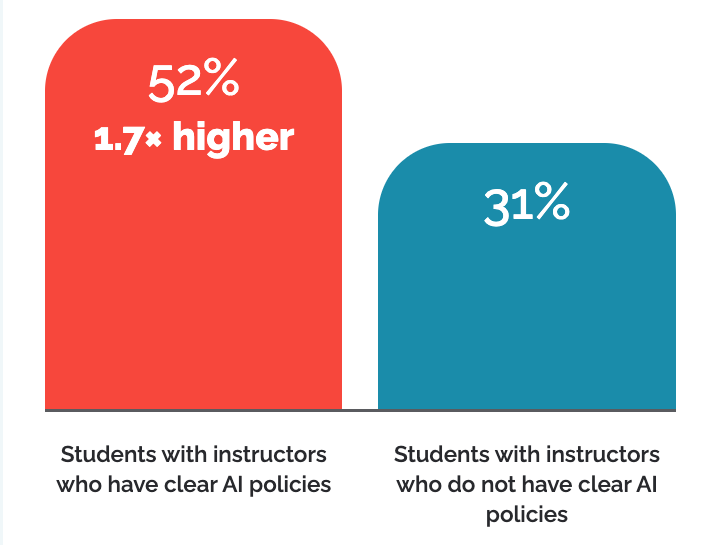
Equity in access and student success remain core goals of the system, and humanized teaching remains a proven pathway. Faculty have been encouraged to develop an AI policy to deter academic dishonesty. A 2026 CCC student survey by WestEd found a strong correlation between clear AI policies and fear of being accused of cheating.
Transparency is key to building trust, but harsh, rigid policies mixed with instructional experimentation create what some have called “AI whiplash” among students. Leaning in with students, having conversations about the risks and potential of AI, and developing critical AI literacy is our goal. Achieving this goal requires faculty to embrace vulnerability and develop a culture of academic integrity through trust, connection, and intrinsic motivation.
Instead, a growing number of faculty now require online students to come to campus for assessments. That may protect a single exam, but it erodes the access that students who depend on online classes because of work, family and distance count on. Cheating has never been eliminated, and AI will not change that. What course design and an actively engaged human instructor can change is the inclination to misuse AI in the first place.
Clear GenAI instructor policies are correlated with higher cheating-accusation anxiety for students.
“Who wants to offload to AI their grandfather’s story of how their family got here?”
When assignments center what students are proud of, including their families, past experiences and future goals, they validate students’ “funds of knowledge” (Moll et al., 1992) and give students a reason to do the work themselves. Integrity by design reduces the pull to offload learning to AI and keeps online classes online.
Online is now the norm
In 2024-25, 53.4% of student enrollments were in courses with distance education sessions. The Chancellor’s Office acknowledges that agentic AI brings “new challenges to authentic teaching and learning” in online environments, raising “significant ethical, governance, and academic integrity concerns if not intentionally managed by prepared pedagogical practices and careful oversight” (2023-25 DE Report).
Employers want human skills
AI literacy is important to preparing students for the workplace; however, we are amidst a loneliness epidemic. Fewer young people are thriving, and fewer are engaging in the physical world. Humans need conversations with other humans to foster emotional intelligence, creativity, problem solving, collaboration and communication skills. These skills are central to higher education in the AI era, and trust, mattering and belonging are the conditions that enable them.
Educators are depleted
Efficiency-driven systems have come to rely on contingent faculty, and the growth of DE has burned out support staff and faculty who now teach in multiple modalities. Equitable teaching hinges on “connective labor” (Pugh, 2024), and this is precisely what is at risk of being automated in a culture of burnout. Investing in relationship-centered teaching and learning sets the California Community Colleges apart from other systems and makes a clear statement about human-centered principles.
Accreditation requires interaction
Federal rules require regular and substantive interaction (RSI) between instructors and students in distance education, and courses that fall short put federal financial aid eligibility at risk (34 CFR 600.2). ACCJC reviews RSI, and Title 5 requires regular effective contact (§55204). As AI tools make it easier to automate feedback and course communication, colleges need clear, faculty-friendly RSI resources. Humanizing gives faculty concrete, repeatable ways to meet RSI through instructor presence, substantive feedback and instructor-initiated interaction.
Why humanizing works: trust from the first click
Social psychology research shows that the brain unconsciously scans every environment for cues of inclusion or exclusion to decide whether it is psychologically safe. Each student reads those verbal and nonverbal cues through lenses shaped by their social identities: gender identity, age, race, sexual orientation, physical abilities, neurodiversity and more. Humanized teaching cultivates a “welcomeness to engage” through trust, mutual respect, and authentic care (Wood & Harris III, 2015) before moving on to the course content.
Students with minoritized identities are more likely to have received negative cues about their abilities through stereotype threat, structural inequities and discrimination. Open-access colleges serve more diverse students, which calls for intentional design for what Universal Design for Learning (UDL) calls learner variability (CAST, 2024). Asynchronous online classes lack the human cues of a face-to-face room, so presence and trust must be cultivated deliberately.

Humanizing applies to all teaching modalities. It focuses on developing an equity mindset in faculty and support staff through strengthening knowledge about how learning happens. Trust and connection become the guiding principles for using technology.
Grounded in Universal Design for Learning
Humanizing is built on Universal Design for Learning (UDL), the research-based framework from CAST that the Chancellor’s Office is advancing systemwide. The UDL Guidelines 3.0 center learners’ identities and belonging and name bias as a barrier to learning (CAST, 2024). Humanizing adds the relational layer: instructor presence and trust turn UDL’s options into an invitation students accept.
The “why” of learning
Engagement
UDL: welcome learners’ interests and identities, foster belonging and community, and build emotional capacity.
Humanizing: kindness cues in the high-opportunity zone, getting-to-know-you surveys, the Learning Dedication, and warm, wise feedback.
The “what” of learning
Representation
UDL: offer multiple ways to perceive and understand information, and value multiple ways of knowing and making meaning.
Humanizing: a mobile-friendly Liquid Syllabus, short video microlectures, and Conversations Across the Curriculum that bring students’ funds of knowledge (Moll et al., 1992) into course content.
The “how” of learning
Action & Expression
UDL: honor a wide variety of forms of communication and expression.
Humanizing: voice and video options for students and instructors, the Wisdom Wall, and conversation as a form of assessment.
What the Institute will do
In the AI era, we are moving from a society that asks “What do you want to do?” to one that asks “Who do you want to be?” The Institute pursues three linked aims.
Built on what works
The humanizing framework, course design practices and Wisdom Wall from the state-funded Humanizing Online STEM Academy, with five years of equity results behind them.
New for the AI era
New Connection Catalyst assignments, all disciplines rather than STEM only, a community of practice that prepares PD leads to bring relationship-rich PD to their own campuses, and an in-person retreat.
1. Trust and Mattering
Students’ most satisfying online courses are the ones where they felt valued and believed their instructor wanted them to succeed (The RP Group, 2025). All courses, especially online, begin with verbal and nonverbal cues of validation and social inclusion, centering every instructor-student relationship in trust. Faculty apply humanizing elements, including a Liquid Syllabus, a getting-to-know-you survey, and warm, wise feedback.
View a liquid syllabusUDL: Engagement
2. Belonging
Emerging research suggests that belonging is correlated with lower AI mis-use by students (Dickinson, 2026). Humanizing employs activities that validate students’ identities and taps into their “funds of knowledge” (Moll et al., 1992). Intrinsic motivation is leveraged to foster a culture of academic integrity from the inside out. Making conversations with community members part of the learning pathway centers nontraditional ways of knowing and develops the human-centric skills that employers seek beyond AI literacy. Students have agency to respond in writing, voice, or video.
UDL: Engagement · Representation (Building Knowledge) · Action & Expression
3. Community is an outcome
Moving away from a culture of detection toward authentic interactions and ways of learning guides the development of community in all modalities. By centering identities and life experiences, humanizing brings human connection to isolated and burned-out faculty and validates the lived experiences of students while also providing activities that help them examine who they are becoming.
UDL: Engagement (emotional capacity)
Connection Catalysts: new assignments designed for the AI era
A new, growing collection of assignment designs that build human-centric skills and critical AI literacy together, in any modality. Each one asks for something only the student can bring, which lowers the incentive to misuse AI without requiring students to come to campus. They sit alongside proven practices from the Academy, such as the Wisdom Wall.
New · Connection Catalyst
Learning Dedication
Students dedicate their learning to someone who matters to them, then share it with the class. Drawing on possible selves research (Markus & Nurius, 1986), it invites integrity that grows from a hoped-for future self rather than rules alone.
“What if the reason to learn with integrity was someone you love?”
UDL: Engagement (identities, belonging)
Explore the Learning DedicationNew · Connection Catalyst
Conversations Across the Curriculum
Students prepare with AI, then learn from a real 30–45 minute conversation with a person in their community. They reflect on what humans and AI each bring to the table, tied to a course outcome in any discipline.
“What if higher education centered conversations as a way of learning?”
UDL: Representation · Action & Expression
Explore Conversations Across the CurriculumProven practice from the Academy
Wisdom Wall
At the end of a course, students record short voice or video advice for the next cohort, who meet it on day one. Relatable peer role models can boost confidence and ease stereotype threat, and reflecting on their own growth builds students’ self-efficacy.
“Learning is a process of growth.”
UDL: Action & Expression · Engagement
Explore the Wisdom WallThree programs for the California Community Colleges
Each program builds on the last. PD leads learn to bring relationship-rich professional development to their own campuses, faculty and instructional designers redesign their teaching over six weeks, and an in-person retreat deepens the same work while restoring the people who do it.
Accessibility is built in, not added on. In all three programs, participants design new learning activities and teaching approaches to meet WCAG 2.1 AA from the start, the standard required by the updated ADA Title II rule, so colleges grow their capacity for Title II compliance as they humanize their courses.
Program 1 · For PD leads
Leading Relationship-Rich PD: A Facilitator Community of Practice
Prepares faculty and staff who lead professional learning to design and facilitate relationship-rich PD on their own campuses, advancing both professional learning and organizational change. Participants learn together in a cohort that models the practices they will lead.
- Who
- PD practitioners: faculty and staff who lead professional learning
- Format
- Synchronous online community of practice, six 75-minute Zoom meetings
- Offerings
- Four cohorts, one in each ASCCC area
Participants will
- Contrast the learning fostered by one-off workshops and webinars with the learning fostered by relationship-rich professional development.
- Discuss research that links relationship-rich PD with transformative change.
- Identify the components of community-centered PD.
- Develop skills and acquire tools to facilitate their own relationship-rich PD.
- Develop a proposal for administrative support for their PD program.
Program 2 · For faculty and instructional designers
Connection through Curriculum: Fostering Human-Centric Skills through Connection and Community
AI literacy is a genuine educational priority, and it is one part of what workforce data calls for. This program widens the lens, placing AI literacy inside the fuller picture the World Economic Forum describes, where human-centric skills are in high demand and resistant to automation. Teaching is connective labor (Pugh, 2024), and access to it has thinned in recent decades for instructors as much as for students. Participants explore the conditions that build human-centric skills, then extend humanizing practices from course climate to the core of learning with Connection Catalyst assignments that foster integrity through intrinsic motivation and develop AI literacy alongside human-centric skills.
This six-week program pairs an asynchronous course with required synchronous Zoom sessions. Faculty experience a humanized, UDL-designed course as students and leave with documented RSI practices their colleges can point to for accreditation.
- Who
- Instructional faculty and instructional designers
- Format
- Six weeks: asynchronous Canvas course plus required synchronous Zoom sessions
- Offerings
- Two cohorts of 30, each blending two ASCCC areas (A+B and C+D)
Participants will
- Identify workforce data that prioritizes human-centric skills alongside AI literacy.
- Examine research suggesting a de-skilling of human-centric skills over recent decades.
- Design teaching approaches that cultivate trust, mattering and belonging in all modalities.
- Examine learning activities designed to cultivate intrinsic motivation and a culture of integrity.
Program 3 · In-person retreat
Connection through Curriculum: A Future-Ready Teaching Retreat
An intensive, three-day immersion in the Connection through Curriculum program, with faculty wellbeing at its center. Faculty step away from the semester to a retreat setting of quiet and natural beauty. General sessions ground the group in research and a shared vision for teaching in the AI era, and small circles meet wherever participants choose, outdoors or in. Faculty leave rested, reconnected to their purpose and a community of peers, and ready to make connection, human-centric skills and AI literacy part of the curriculum in every modality.
- Who
- Community college faculty teaching online, hybrid and on campus
- Format
- Three days, in person
- Offerings
- One statewide, fee-based retreat for 100 participants at the end of the academic year, with three paid facilitators
Participants will
Reset
- Articulate a vision for the AI era in which AI literacy and human-centric skills grow together.
- Make the case for relational teaching as core to higher education’s value.
Reclaim
- Name the relational practices that make a teacher memorable for decades.
- Identify practices and draft assignments that build human-centric skills, integrity and AI literacy.
Restore
- Leave rested and reconnected to the purpose that drew them to teaching, and to a community of peers.
- Return with practices that sustain meaning in teaching over time.
A regional offering, building on the RPDNs
The Chancellor’s Office Academic Affairs team has validated that faculty and staff want to build relationships with more peers across their region. The Humanizing Institute builds on the RPDNs by offering PD for PD practitioners, increasing peer-to-peer connections while centering human connection in the advancement of pedagogy and course design in the AI era. It also advances the Chancellor’s Office’s commitment to Universal Design for Learning and accessibility.
Year 1
Regional PD for PD practitioners, faculty and instructional designers
- Leading Relationship-Rich PD: offered within each ASCCC area.
- Connection through Curriculum: offered twice, with each cohort blending two areas (A+B and C+D).
- Connection through Curriculum Retreat: offered at the end of the academic year for a statewide audience. This fee-based event keeps costs as low as possible by choosing a rustic retreat set in nature, with three paid facilitators.
Throughout
Collect data
Pre- and post-surveys will measure changes in wellbeing, engagement with teaching, and self-efficacy with AI.
Year 2 and beyond
Grow through grant funding
Seek grant funding to scale the Humanizing Institute through additional offerings and research.
Led by
Michelle Pacansky-Brock
Visiting expert in professional development and AI with the California Community Colleges Chancellor’s Office, and creator of the Humanizing Online Teaching framework. Michelle led the Humanizing Online STEM grant work (2019–2024) and is the author of Best Practices for Teaching with Emerging Technologies (Routledge).
Sources
- Bakersfield College Academic Technology. (2024). Empowering online STEM education: A journey of inclusive pedagogy.
- California Code of Regulations, Title 5, §55204. Instructor contact.
- California Community Colleges Chancellor’s Office. Universal Design for Learning resources. California Community Colleges UDL resources
- California Community Colleges Chancellor’s Office. (2025). 2023-25 distance education Board of Governors report.
- CAST. (2024). Universal Design for Learning Guidelines version 3.0. udlguidelines.cast.org
- Dickinson, J. (2026). Trained to stop learning: How students are experiencing assessment and learning in an age of AI. Wonkhe.
- Estrada, M., Eroy-Reveles, A., & Matsui, J. (2018). The influence of affirming kindness and community on broadening participation in STEM career pathways. Social Issues and Policy Review, 12(1), 258–297.
- Huebner, T., & Pedroza, V. (2026). Listening to students first: What California community college learners are telling us about GenAI, equity, and learning. WestEd. (Additional WestEd analysis of survey data.)
- Ledezma, G. M., Xu, D., & Pacansky-Brock, M. (2025). Humanizing online STEM: Preliminary research findings, Brief #2. HumanizeOL.org.
- Markus, H., & Nurius, P. (1986). Possible selves. American Psychologist, 41(9), 954–969.
- Moll, L. C., Amanti, C., Neff, D., & González, N. (1992). Funds of knowledge for teaching: Using a qualitative approach to connect homes and classrooms. Theory Into Practice, 31(2), 132–141.
- Pugh, A. J. (2024). The last human job. Princeton University Press.
- The RP Group. (2025). Results from a comprehensive California Community Colleges online education study: A report to the 2024–2025 California State Legislature. Commissioned by Senate Bill 117.
- U.S. Department of Education. Definition of distance education, including regular and substantive interaction. 34 CFR §600.2 (effective July 1, 2021).
- Wood, J. L., Harris, F., III, & White, K. (2015). Teaching men of color in the community college: A guidebook. Montezuma Publishing.
- World Economic Forum. (2025). New economy skills: Unlocking the human advantage.
- Xu, D., et al. (2022). Humanizing online STEM: Preliminary research findings. HumanizeOL.org.
The Humanizing Online STEM projects were supported by the California Education Learning Lab. Learn more at HumanizeOL.org.
Liquid Syllabus created by and shared with permission from Eric Martinsen of Ventura College. Photo by personalgraphic.com on Unsplash.